O and I went on the MCCS tour down to Naha for the annual Tug-of-War. Z wasn't sure he'd be able to make it, so he ended up driving down and meeting us on his own.
I'm very glad we took the tour. We had transportation and didn't have to search/fight for parking. It was a lot of stress off of me. They also provided a tour guide who told us some of the history to the event which made the whole thing more exciting and meaningful. It also helped with the wait time between events since I knew what was coming. My husband didn't enjoy it as much because he didn't really know what was happening and doesn't like to stand around.
Our guide told us that Naha hosts the Tug-of-War every year on the Sunday closest to October 10th as a way to commemorate the lives of those lost on both sides when the Americans invaded Naha in 1944 during the Battle of Okinawa.
Tug-of-Wars exist all over the island, but Naha's is by far the largest. The core of the rope remains in tact each year, but the outside is reconstructed completely out of straw for the next event. This is partially due to the fact that it is considered good luck for your household to take home pieces of the rope (especially from the winning side) and also to maintain the Guinness World Record. This years rope measured 200m (656 feet) in length, and weighed more than 40 metric tons (44 American tons)!
 The story behind the tug-of-war beginnings on island goes as follows (As best as I can recall from listening to our guide):
There once was a time in Okinawa where the elders of the population were forced out of the villages once they reached a certain age so that they would not be a burden on the community. They were to fend for themselves in the countryside and if they lived, they lived, and if they died... they died.
 One year, a plague of insects overtook the fields and the farmers could not figure out how to get rid of them. They tried every way they could think of, but nothing worked. The Lord of the Land sent word that something must be done to end this crisis and whoever found the solution would be rewarded. The villagers continued with their efforts, but were still unsuccessful.
 One man decided to go into the hills to where his father lived and asked him for advice. The father told him to gather the gongs and light torches that would create as much smoke as possible and hold a tug-of -war in the field at night. The gongs and the shouting would scare the insects and the torches and smoke would make them think that the field was on fire and the insects would flee.
The man took this advice back to his village and a tug-of-war was held soon after. The insects did indeed flee the field. The Lord of the Land heard of their success and it was reenacted in every field that was plagued by insects. He then came down to reward the young man for his solution.
The man confessed that it was not his idea but that of his father. The Lord of the Land determined that it was unwise to cast out the elderly into the hills for their wisdom and life-experience should be respected and was a valuable asset to the community. From that day forth, the practice of sending elders into the hills was no more and tug-of-wars have taken place throughout the island every year.
The Naha tug-of-war pits the East vs. the West.
 Before
the tug-of-war, the Ufunnasunei parade is held on Kokusai Street. The parade consists of 14 hatagashira (flags/decorative poles), their bearers, and their escorts comprised of musicians and performers.
Before
the tug-of-war, the Ufunnasunei parade is held on Kokusai Street. The parade consists of 14 hatagashira (flags/decorative poles), their bearers, and their escorts comprised of musicians and performers.
 7 flags represent the West and 7 the East. These flags are symbols and good-luck charms of the districts in which the flag bearers live. Western districts: Izumizaki, Wakasa, Oroku, Kakinohana, Kume, and Tsuzi. Eastern districts: Asato, Shuri, Tomari, Mawashi, Kumoji, and Tsuboya. Each side also has a lead flag.
Flag bearers are denoted by their special
black uniforms called Mumunuchihanta. It is very difficult to maneuver these 30 ft tall flags so it is a great honor to be chosen. Flag bearers balance the flags on their stomachs and move rhythmically in time with their escorts banging of drums and brass gongs and the blowing of conch shells. The performers that accompany them put on displays of martial arts for crowds awaiting the arrival of the next hatagashira. And every now and then firecrackers are set off throughout the parade.
7 flags represent the West and 7 the East. These flags are symbols and good-luck charms of the districts in which the flag bearers live. Western districts: Izumizaki, Wakasa, Oroku, Kakinohana, Kume, and Tsuzi. Eastern districts: Asato, Shuri, Tomari, Mawashi, Kumoji, and Tsuboya. Each side also has a lead flag.
Flag bearers are denoted by their special
black uniforms called Mumunuchihanta. It is very difficult to maneuver these 30 ft tall flags so it is a great honor to be chosen. Flag bearers balance the flags on their stomachs and move rhythmically in time with their escorts banging of drums and brass gongs and the blowing of conch shells. The performers that accompany them put on displays of martial arts for crowds awaiting the arrival of the next hatagashira. And every now and then firecrackers are set off throughout the parade.
 O was not a fan of the firecrackers at all. However, even she was drawn into watching the parade. She mostly spent her time staring at the children playing the instruments or carrying smaller flags. But she did intently watch the men "bouncing" the hatagashira on their stomachs. A couple times large gusts of wind threatened to knock them over onto us. I wasn't worried though because they had an entourage of guys with long poles for catching and redirecting them in situations like this.
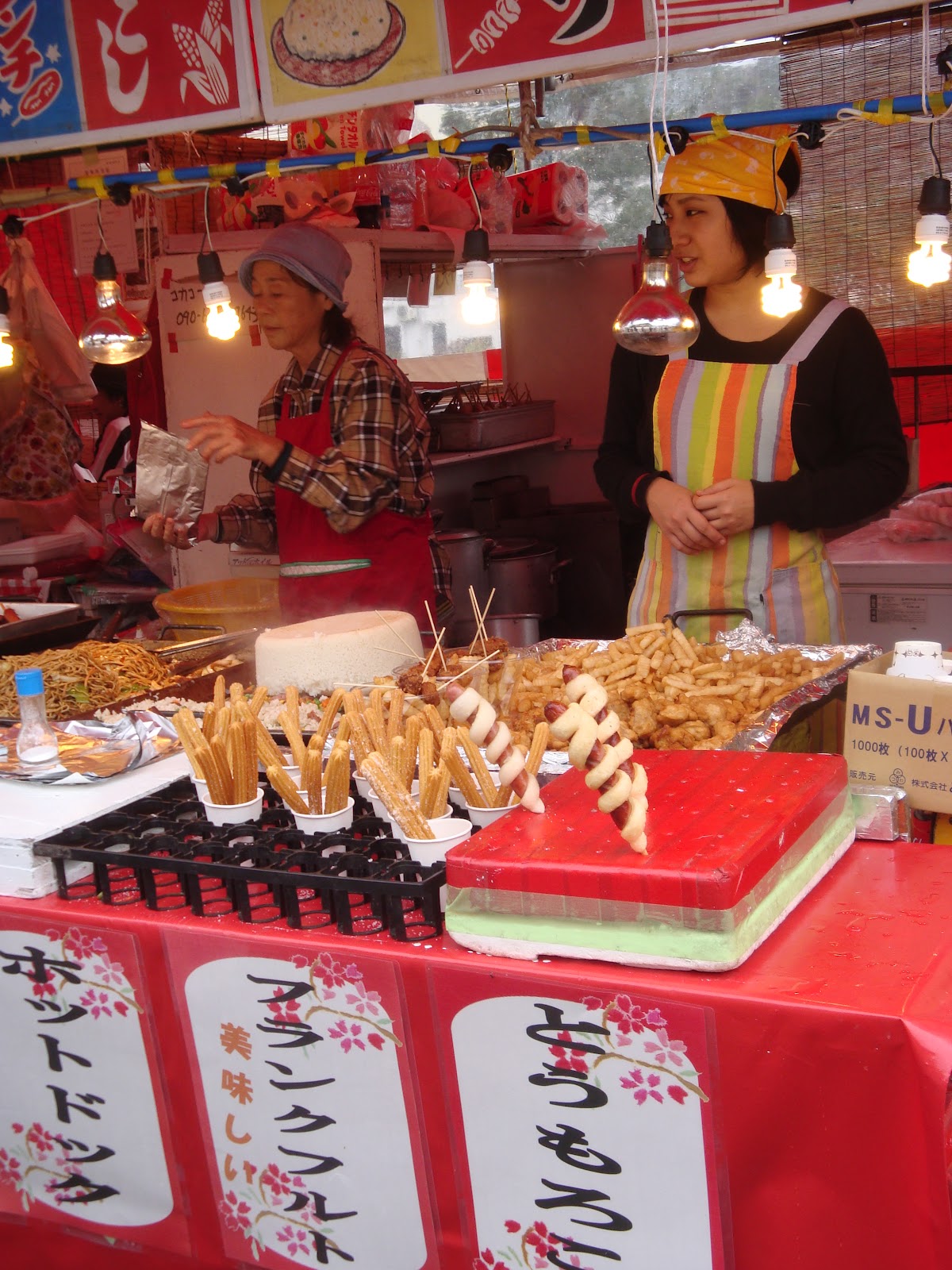
When the parade was done, we stopped at one of the many stands selling festival food on our way back to the rope site. Z thought he was getting naan but it was actually a sort of flat bread with ham and cheese baked inside. It was delicious! I wish our noodle dishes had been half as good. They were still tasty, but I could have lived on that bread for the day.

Next time I think we'll eat during the parade because we weren't able to get a spot to watch the opening festivities for the actual tug-of-war. At the center of the rope they have martial arts, shisa dogs, and eisa dancing before the ceremony begins. Then the hatagashira are brought in to designate their sides and assemble their teams. A few speeches are made. Participants help move the two halves of the rope to the center where it is then connected by a 10 foot wooden pole. Then, the Kings of the East and West come down their ropes to meet in the center. They have a fake dual and then announce the tug-of-war begun. The giant golden ball hanging over the center of the rope is split in half releasing balloons and confetti and a giant flag/banner drops down signaling teams to begin pulling.

Z & O were not participating in the tugging, so they were watching as best they could near the center. I was tugging for the East, so I was able to see our King and his two court attendants enter and exit. Parents were encouraged to take their children to the sidewalks once the actual tugging began due to the dangers involved in being in an event of that size.
It was good advice actually. I had several children around me who I helped hold up so they could see the King go by. Only one got to stay for the actual tugging and her mother was having a difficult time keeping her on her feet. I was even getting pretty smashed by the people around me. I would describe it as a giant mosh pit. The only real difference being that everyone is trying to move together instead of doing their own random thing.
The goal is to move the rope a total of 5 meters (about 15 feet) within
30 minutes. If by the end of 30 minutes there is not a clear winner, the
match is declared a tie. After 15 minutes, we were all pretty tired and our intensity was starting to wane. Suddenly, some Japanese people hopped on to the end of our rope and started pulling with us and screaming "Hai-ya", which I guess means pull harder. With them and our motivator guys standing on the rope calling out to us, we caught a second wind (so it seemed) and we were able to noticeably move the rope. It was awesome! It almost semed like we all tripped backwards at the same time, lol.

We continued with our goal to see this tugging to the end and were able to get one more giant tug in our direction just minutes before the match was over. Exhausted, sweaty and smiling and laughing alongside our Japanese and American neighbors, the winner was announced... EAST WON! GO TEAM!

Someone was nice enough to cut off the strand of rope I had been holding onto for at least an hour for me so I could take it home. My own personal piece of memorabilia from a truely fantastic cultural event. Really, who could ask for more?
The tour we were on gave you the option to leave at 1700, 1800, or 1900 after the tug-of-war was over so you could enjoy the rest of the festival as you saw fit. I would've liked to stay longer, but O needed to go home and go to bed and honestly I was a little sore from tugging. We chose to hop the earliest bus back to base. I repeat from earlier in this post, taking the tour was a great idea. Go, have fun and participate, NO DRIVING. We could just relax on the way home and not worry about traffic. I will definitely be taking the tour again next year. :D
 If you're looking for a fun, laid back event to attend around the holidays, the Okinawa Santa Run is for you. The registration fee includes a one-size-fits all Santa suit for adults and a Santa hat for children. The money raised goes to provide Christmas presents to children spending Christmas in local hospitals.
 Besides, they had plenty of live entertainment to keep us occupied. Among these were a band playing festive tunes, pop dancers, a jazz singer and many more.